
Felony, Misdemeanor or Wobbler? How California Decides
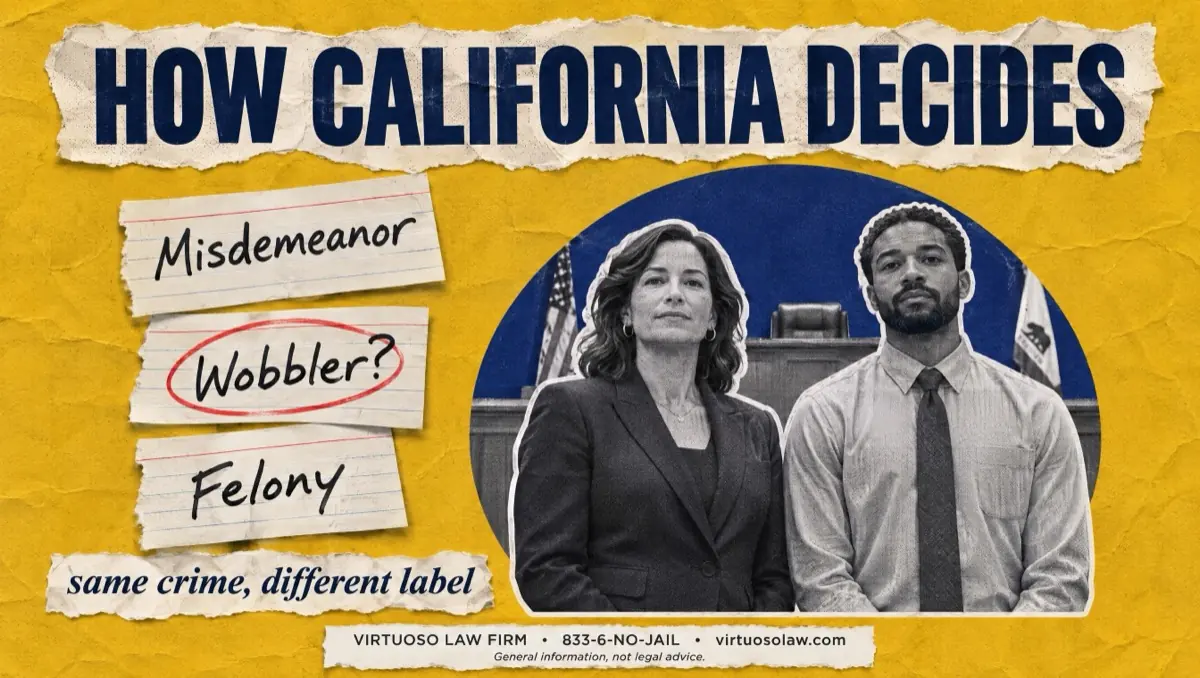
Two people can be arrested for similar conduct, and one ends up with a misdemeanor while the other faces a felony. In California the label affects much more than the sentence. It follows you into job applications, professional licenses and gun ownership. This guide explains how California sorts crimes and what a wobbler is. It is general information, and your case depends on its own facts.
Infractions, misdemeanors and felonies
California divides crimes into three categories. Infractions are the most minor offenses and usually have little effect on your record. Misdemeanors are more serious. They cover everything from theft to battery and can mean up to one year in county jail. Felonies are the most serious crimes. A felony is a crime that can be punished by more than a year in jail, and felony sentences often mean state prison. Our page on felony consequences goes through the differences.
Even a felony that ends in probation carries lasting consequences, which is why people worry about the label from the first day of a case.
What is a wobbler?
Many crimes can be charged either way, and lawyers call these wobblers. A few examples:
- Burglary (PC 459), which we explain in our guide to burglary
- Criminal threats (PC 422), covered on our criminal threats page
- Grand theft (PC 487), described on our grand theft page
- Carrying a concealed firearm (PC 25400), on our concealed carry page
The penalties show how wide the gap is. Grand theft, for example, can mean up to one year in county jail as a misdemeanor, or 16 months, two years or three years as a felony.
A wobbler stays a wobbler until the case is decided, so people often do not know whether the charge will count as a felony or a misdemeanor until the end. That uncertainty is one of the hardest parts of these cases.
Who decides whether a wobbler is a felony or a misdemeanor?
The prosecutor makes the first decision when filing the case, based on the facts and your criminal history. A judge can sometimes reduce a felony wobbler to a misdemeanor later, for example at a preliminary hearing or after you finish probation.
Under PC 17(b), a felony conviction can be reduced to a misdemeanor if the sentence was probation and not jail, and the crime could have been charged as a misdemeanor. Not every felony qualifies. Our page on felony reduction under PC 17(b) explains who can apply.
What a felony conviction costs beyond the sentence
- Employment. Many job applications ask whether you have ever been convicted of a felony, and a yes can end your chances.
- Professional licenses. People in fields such as medicine, nursing, pharmacy, law and teaching can lose a license they already hold or be denied a new one.
- Guns. California and federal law bar people with felony convictions from owning a firearm or getting a license to carry. An expungement does not change that.
- Immigration. A conviction can have serious immigration consequences. See our page on immigration and criminal law.
Getting a felony reduced or cleared
PC 17(b) is the main route from felony to misdemeanor. An expungement under PC 1203.4 lets you withdraw your plea and have the conviction dismissed after probation, but it does not completely seal your record, and by itself it does not restore gun rights. Our expungement eligibility tool is a good place to start, and our page on expungements explains the process.
If you are charged with a wobbler
- Talk to a lawyer early. The choice between a misdemeanor and a felony is often shaped in the first weeks, through the evidence and the negotiation.
- Ask what any plea would do to your record, your job, your license, your immigration status and your gun rights before you agree to it.
- Keep every court date and follow every condition of probation. A later reduction usually depends on how probation goes.
Theft and burglary are among the most common wobblers. Our guide to robbery, burglary and theft shows how those charges differ. If you need help with a felony reduction, our Hayward and San Jose offices handle them, and your first consultation is free.